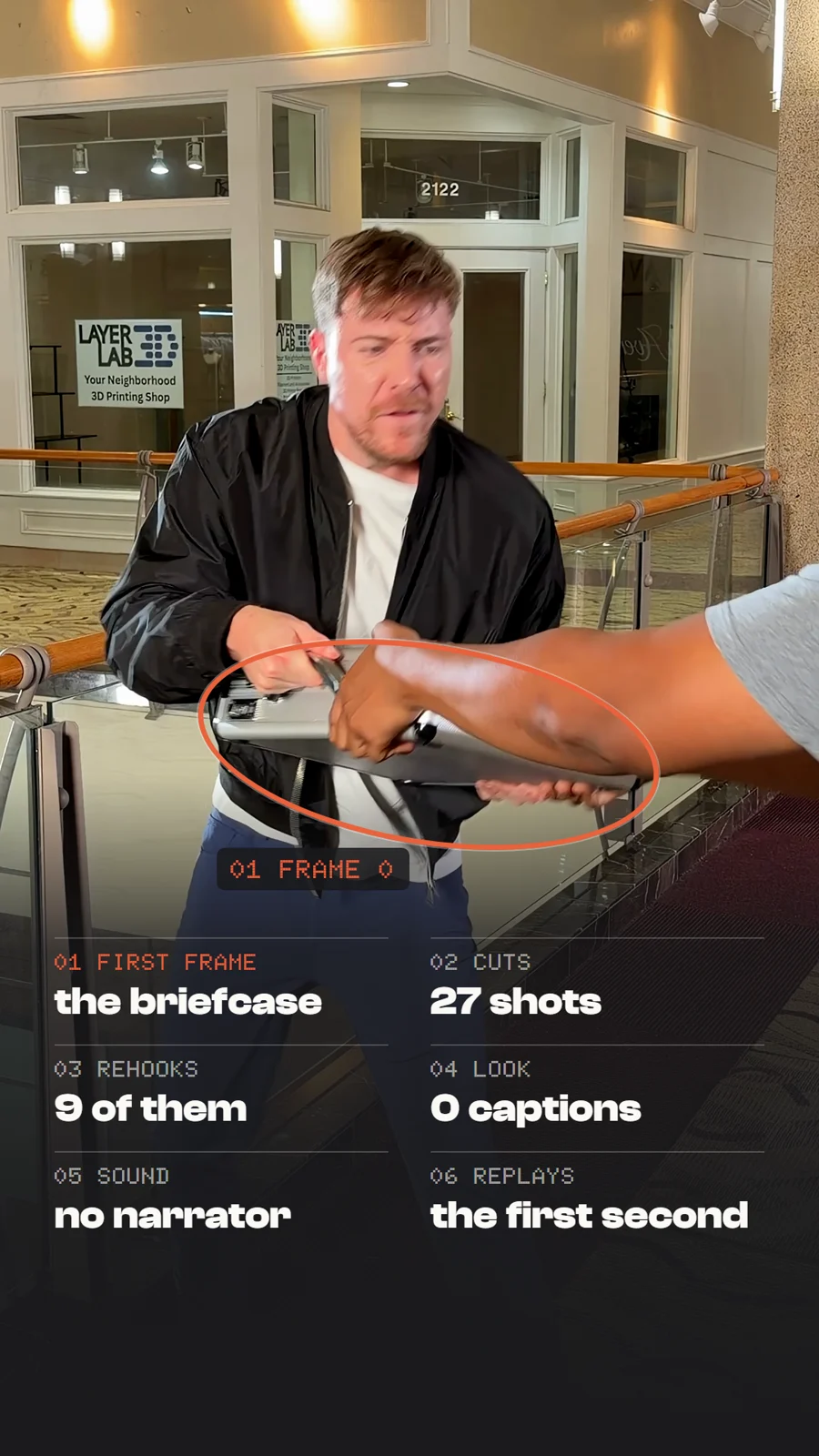
Claude can watch videos now. A free skill called watch hands it the frames and the transcript, and a second skill, viral-format, measures every cut and the sound, then answers six questions about the edit. Below are all six answers for MrBeast’s 115M-view Short, and the steps to get them for any reel you like.
the six steps, on one Short
 01The first framethe briefcase
 02The cuts27 shots
 03The rehooks9 of them
 04The look0 captions
 05The soundno narrator
 06The replaysthe first second
sound familiar?
A format is what stays when you take the subject away.
What you need
 Claude Code
- A link, or the video file
 Python, ffmpeg and yt-dlp
Install the watch skill and viral-format
Two pieces. One lets Claude see the video, the other tells it what to look for.
Downloads the video, pulls one frame per shot and the transcript.
By Taoufik, built on claude-video by Bradley Bonanno.
My skill: the six steps, the one-page format, and how to cut your clip to it.
Comes with measure.py: every cut, the loudness and YouTube’s most-replayed graph.
say to Claude
Install two skills. First the watch skill: git clone https://github.com/taoufik123-collab/claude-watch.git ~/.claude/skills/watch. Then download https://engram.media/guides/viral-reel-breakdown/viral-format-skill.zip and unzip it into ~/.claude/skills, so that ~/.claude/skills/viral-format/SKILL.md exists. Then check that Python, ffmpeg, ffprobe and yt-dlp are installed, and tell me what is missing.
Prefer plugins? Add watch from its marketplace instead of the git clone, and unzip viral-format by hand into ~/.claude/skills.
type in Claude Code, one line at a time
/plugin marketplace add taoufik123-collab/claude-watch/plugin install watch@claude-watch
what is in the zip
viral-format/
SKILL.mdthe six steps and the rulesscripts/measure.pymeasures the cuts, the frames, the loudnessreferences/format-template.mdthe empty pagereferences/example-format.mdKevin Parry’s, shown belowreferences/example-format-2.mda Mark Rober Short, with no transcript
Paste a link
Run this one first, as it is. It is the same Short, so your numbers should match mine: 39.8 seconds, 27 shots. Then swap in the reel you want.
say to Claude
Break down this reel with the viral-format skill: https://www.youtube.com/shorts/CEJXqm2eiJ0. Run the watch skill on the link, so the captions come with it, then measure it. Look at every frame, check every cut, and answer the six steps. Say which answers are your judgement, and leave out what you cannot support. Write FORMAT.md, then delete the video.
what comes back first: the measurements
39.761 s, 27 shots, mean 1.473 s, median 1.066 s, shortest 0.6 s, longest 4.266 s; loudness -10.9 LUFS, range 6.3 LU
Instagram and TikTok often refuse the download without a login, and the skill never logs in. So get the video onto your computer and hand Claude the file. You lose the replays, which only YouTube has, and the words need a Whisper key (see the quick fixes).
say to Claude
Break down this video with the viral-format skill: ~/Downloads/reel.mp4. It is a file, so skip the download and the replays, and say so. Look at every frame, check every cut, and answer the other five steps. Write FORMAT.md.
| from | download | the words | replays |
|---|---|---|---|
| YouTube Short | the link works | captions, when YouTube gives them | on popular videos |
| Instagram, TikTok | often refused: use the file | needs a Whisper key | no graph |
| A video file | nothing to download | needs a Whisper key | no graph |
The first frame
it answersWhat is literally on frame 0? Is it complete, or still arriving? What question does it put in your head?
MrBeast’s answer
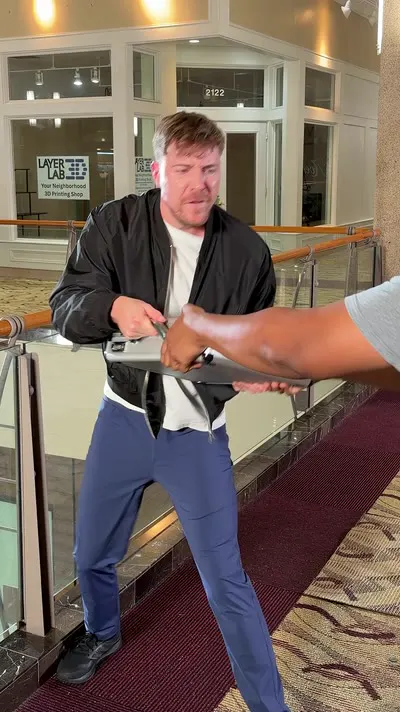
The briefcaseThe title’s question, in his hands, complete on frame 0.
Frame 0 is the silver case in both his hands, with a second pair of hands pulling on it. Nothing is still arriving. The title asks what is inside his briefcase, and the first frame puts that briefcase in front of you.
The cuts
it answersHow long is it, how many shots, how long is the average shot, and which shot is the longest and why is it allowed to be?
MrBeast’s answer
- 39.8 s
- long
- 27
- shots
- 1.5 s
- a new one every
The longest shot is 4.3 seconds, and it is the ad. In the chase the longest is 4.1 seconds: one unbroken move over a table and through the guards. My judgement: it can hold because the stunt in it does the work a cut would do.
The rehooks
it answersWhen does a viewer who was about to leave get a new reason to stay? A rehook is a new threat or a new place. Claude lists each one with its second, counts them and gives the gap.
MrBeast’s answer
- 9
- rehooks
- 3.3 s
- one every
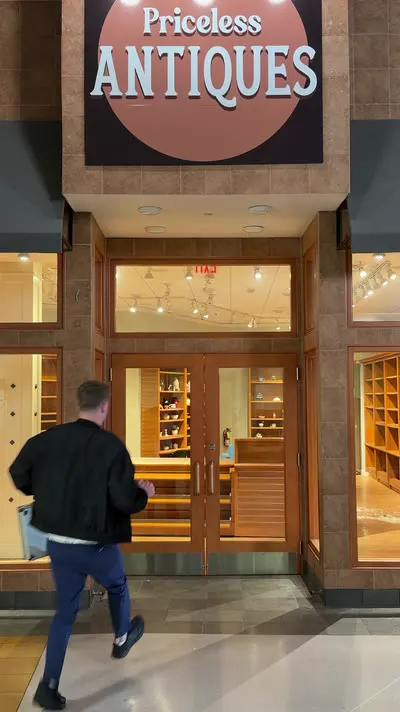
 1.1 s over the railing
 3.3 s guards
 4.9 s Segways
- 6.5 s the crowd
 7.4 s the antique shop
 10.7 s the shelves fall
 17.5 s over the table
 24.4 s the getaway car
- 29.6 s the case opens
This count is a judgement, and so is yours. Another producer might add the shop door or leave out the crowd. What matters is the definition and the list, so you can check each one against the video.
The look
it answersWhat does a viewer see without thinking? Captions or none, where the words come from, how close the camera is, what stays in frame.
MrBeast’s answer
- 0
- captions
The place tells you where you are.
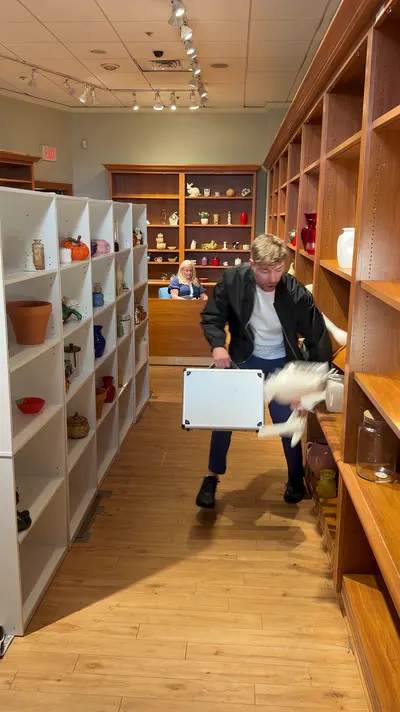
The case stays in the shot.
No caption anywhere. The words on screen are signs in the world, until the ad lays a pack and three store badges over the picture. From shot 3 to shot 9 the camera swings wide, close, wide, close on every cut. And when he is on screen in the chase, the case usually is too, so the question stays in the picture.
The sound
it answersIs there a narrator? When does the first full sentence come? What is the loudest second, and what happens right after it?
MrBeast’s answer
- No
- narrator
- 31.6 s
- first full sentence
- 6.3 LU
- loudness range
No narrator. In YouTube’s captions it is shouts and short lines until 31.6 seconds, then the first full sentence: “Finally, my collection is complete.” After the opening, the loudest moment is about 29 seconds, and the case opens at 29.6.
Claude will not tell you there is a hit on every cut, or a music bed under it, unless you measured it or heard it yourself. Numbers cannot hear. If the sound matters to your format, listen.
The replays
it answersWhere does YouTube’s most-replayed graph peak, how fast does it fall, and where does it hit the floor?
MrBeast’s answer
The peak is the first second. It is down to half by 1.6 seconds, and the floor is 35.6 seconds, inside the ad: the least replayed moment of the Short. This graph shows what people watch again. It says nothing about who stayed or who left, so read it that way.
YouTube gives it for popular videos only, and Instagram and TikTok have nothing like it. If it is not there, Claude skips the step and says so.
The page it writes
All six answers end up on one page, FORMAT.md. The test for every line: it must still be true with a different subject. “Opens on a briefcase” is content. “Opens on the object the title asks about, already in someone’s hands” is a format.
Here is a real one, written from a Kevin Parry Short.
a real FORMAT.md, word for word
FORMAT: The impossible object, then the hands
Measured from: “Recreating the Netflix Intro with $30 Worth of Yarn”, Kevin Parry, 49,712,691 views, 29 s, youtube.com/shorts/O52HNleBH4w, read 2026-10-30. Its speech was not read (the captions refused with a 429), so the rules below come from the picture and the measurements.
In one line
Show the finished thing where a person would meet it in real life, say the absurd cost of it, then spend the rest proving it by hand.
The numbers
| Length | 29.0 s |
|---|---|
| Shots | 18 |
| Average shot | 1.6 s (median 1.4 s) |
| Longest shot | 5.2 s, and it is the first one |
| Shortest shot | 0.17 s |
| Loudness | -18.0 LUFS, range 7.3 LU |
| Words on screen | one caption, on the first shot |
The first two seconds
- Frame 0: a real room with a TV on the wall, the screen dark, the caption already there. Judged, not measured: it looks like someone’s living room, not a graphic.
- Complete on frame 0: the caption, one line in a red box, naming the famous thing and the price.
- By 1.5 s the famous mark is on the TV. The viewer knows what it is, and the caption says it should not be possible.
The beats
| s | Beat | What it does for the viewer |
|---|---|---|
| 0 to 5.2 | The result, in the room, one held shot | Gives the payoff first, in a place that makes it feel real |
| 5.2 to 9.4 | The raw material, flat on a table | Answers “out of what?” |
| 9.4 to 14.6 | The maker, working, his face in frame | A person, tools, effort |
| 14.6 to 24.5 | The rig: the same result seen from the side | The trick is shown and is still impressive |
| 24.5 to 29 | The wide view of the whole setup | Everything in one picture |
The rules
- Open on the finished thing inside a real place, never as a flat screen graphic.
- Hold that first shot far longer than any other: about a sixth of the whole video.
- One caption on frame 0: the famous thing plus the absurd constraint. No other words on screen.
- After the first shot, never hold longer than about 2 s.
- Every shot after the first shows a hand, a tool, a face or a rig. Nothing is summarised with text.
- Let the sound move: the range is 7.3 LU. Quiet spots sit next to loud ones.
- End on the whole setup, not on a call to action.
Do not copy
His footage, his yarn, his rig, his words, and the brand’s own logo as a stunt without thinking about whose mark it is.
How to check a recreation
Same order of beats. A first shot of about 5 s, and about 1.6 s after it. One caption, complete on frame 0.
Cut your own clip to it
Now give it your footage. Claude maps each beat to a moment of your clip and holds the numbers. If a beat has no match it stops and tells you, because a format with a missing beat is a different format.
say to Claude
Here is my clip: ~/Videos/my-clip.mp4. Recreate FORMAT.md on my footage. Map every beat of the format to a moment of my clip, and if a beat has no match, say so and stop. Hold the numbers: the shot length, the first frame, the time of the first word, the length of the whole piece. Build it in HyperFrames and show it to me live before you render anything. Then put the original's measurements beside the new cut's and tell me where they differ.
check the new cut against the format
Only the structure moves across. Never reuse the original’s footage, words, music or title.
Quick fixes
Can Claude really watch a video?
On its own, no. The watch skill downloads it, pulls one frame for every shot, a closer look at the first 10 seconds and the transcript, and Claude reads those as pictures and text. That is why it can point at a second instead of guessing from the title.
The download failed
Instagram, TikTok and private videos often need a login, and the skill never logs in. Save the video to your computer and use the file prompt above.
It says there is no transcript
YouTube sometimes refuses the captions with an error 429. It did on two of the three Shorts I tested, and it is out of your hands. The fix is a Whisper key: put a Groq or an OpenAI key in ~/.config/watch/.env and watch hears the video itself. It needs the same key for a video file. With no key, Claude works from the picture and the loudness, reads whatever is printed on screen, and says the speech was not read.
The number of cuts looks wrong
That is why the prompt says check every cut. A fast zoom can read as a cut and a soft move can hide one. On a Mark Rober Short the count was 28 and one was false, and a flat drawing hid about three more. If it missed some, say: run measure.py again with --threshold 0.15 and look at the frames either side of each new cut.
My rehook count is not the same as yours
It is a judgement, so it can differ. Keep the definition (a new threat or a new place), read the list with its seconds, and move any you disagree with.
The format reads like a summary of the video
Say: every line must still be true with a different subject, so rewrite each line that only fits this video.
An independent guide by Luka (@omgluka), made at Engram. The worked example is “What’s Inside My Briefcase?” by MrBeast: 109.8M views when I first measured it on 28 October 2026, 115.7M on 30 October. Its frames are his, shown small to teach the breakdown. The format page is from a Short by Kevin Parry. The watch skill is by Taoufik, built on claude-video by Bradley Bonanno, MIT licence. yt-dlp and ffmpeg are open-source projects. Claude and Claude Code are made by Anthropic. None are affiliated with this guide.